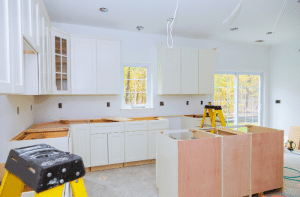
A fixed-price contract sets the cost of your renovation before work begins. A cost-plus contract means you pay the actual cost of labour and materials plus the builder’s margin, and the final figure is not known until the project is complete. For renovations in Melbourne’s east, where older homes regularly hide surprises behind walls and under floors, the contract type you choose determines who pays for those surprises: you or your builder.
At NPR Building Concepts, we focus on fixed-price contracts for clearly defined renovation scope because renovations are genuinely different from new builds. The right choice depends on your project’s scope, your home’s age, and your tolerance for financial uncertainty. This guide explains how each structure works specifically for renovation projects.
For the broader pathway, see our full knockdown rebuild process guide for Melbourne’s eastern suburbs, and visit NPR Building Concepts services when you are ready to discuss your project.
Why Renovations Are Different from New Builds
New builds happen on cleared land. The builder controls every variable from foundation to roof. A fixed-price contract on a new build is straightforward because the scope is fully defined.
Renovations are different. Your builder is working inside an existing structure that was built decades ago, often to standards that no longer apply. Opening a wall in a 1960s brick veneer in Ringwood might reveal:
- Asbestos sheeting or insulation
- Substandard wiring that needs replacing
- Termite damage in the framing
- Plumbing that does not meet current code
- No insulation at all
These discoveries are not design failures. They are the reality of renovating older homes. The question is: who pays?
How Fixed-Price Works for Renovations
The builder assesses your home, defines the scope of work, and quotes a total price for that agreed scope. The contract still sets out exclusions, allowances and the process for documented variations, so a fixed price is not a promise that every possible condition or change will be absorbed by the builder.
Advantages for Renovation Projects
Budget certainty. You know what the renovation will cost before demolition starts. Critical for homeowners financing the work through a home equity loan or redraw.
Risk protection. Within the agreed scope, the builder carries the cost risk of delivering the work at the quoted price. Who pays for something found behind a wall, such as asbestos, depends on how the contract treats it: as included work, an exclusion, a provisional sum or a documented variation.
Financing clarity. A fixed-price contract can make the project easier for a lender to assess, but lending requirements vary. Check what your lender needs before choosing a contract structure.
Disadvantages for Renovation Projects
Higher price. Because renovations carry more unknowns than new builds, a builder issuing a fixed price on a renovation project will include a larger risk margin (often 10% to 20%) to cover potential discoveries. You pay for that margin whether surprises occur or not.
Conservative scope. Some builders avoid offering fixed-price contracts on renovations altogether because the risk of hidden issues is too high. Those who do offer it may define the scope conservatively, with extensive exclusion clauses for items like asbestos, structural defects, or non-compliant services.
Limited flexibility. Once the fixed price is set, every change you request is a formal variation. In a renovation, where you often discover better design options once walls are open, this can feel restrictive.
The Exclusion Trap
Watch for fixed-price renovation contracts that exclude the very risks you want protection from. If the contract excludes “unforeseen structural defects,” “hazardous materials removal,” and “non-compliant services rectification,” the fixed price protects you from very little. These are exactly the surprises that occur in renovations.
Read the exclusions more carefully than the price.
How Cost-Plus Works for Renovations
You pay the actual cost of all labour, materials, and subcontractors, plus the builder’s margin (typically 15% to 25% for renovations, or a fixed management fee). The builder provides an estimate, but it is not a cap. Victorian law restricts cost-plus contracts. They are generally allowed only where the work is reasonably estimated to cost $1 million or more, or for renovating an existing building where the cost of a substantial part of the work cannot be calculated without first carrying out some of the work. Get independent legal advice before signing.
Advantages for Renovation Projects
No built-in risk buffer. The estimate reflects what the builder genuinely expects the job to cost, without a risk buffer inflating the number. If the renovation runs smoothly, you pay less than a fixed-price equivalent.
Flexibility within the contract. When you open the kitchen wall and discover the perfect spot for a window, the scope may be adjusted, but the change still needs to be documented under the contract and Victorian building law. You pay the actual cost allowed by the agreed process.
Useful where costs cannot be priced upfront. On a renovation under $1 million, cost-plus is generally only an option where a substantial part of the work cannot be priced without first opening up the home, such as a subfloor or wall with unknown conditions.
Transparency. You see every invoice. You know exactly what the plumber charged, what the electrician billed, and what the materials cost. No hidden margins.
Disadvantages for Renovation Projects
No budget ceiling. If a major renovation was estimated at $1.2 million and actual costs hit $1.4 million, you pay $1.4 million. The estimate was a guide, not a commitment.
You carry all risk. Asbestos behind the cladding? Your cost. Restumping needed? Your cost. Rewiring the whole house because the existing circuits are dangerous? Your cost.
Requires active monitoring. To stay on budget, you need to track actual costs against the estimate weekly. Not all homeowners have the time or expertise for this.
Margin incentive misalignment. A builder on a percentage margin earns more when the project costs more. Most builders are ethical, but the structural incentive is worth acknowledging.
Side-by-Side for Melbourne Renovations
| Factor | Fixed Price | Cost Plus |
|---|---|---|
| Budget certainty | High (for agreed scope) | Low |
| Who pays for hidden surprises | Depends on the contract (inclusions, exclusions, provisional sums, variations) | You |
| Typical risk margin | 10-20% built into price | None (but estimate may be conservative) |
| Flexibility for changes | Limited (variations required) | Higher, but changes still need to be documented |
| Best project types | Defined scope, cosmetic/structural with pre-investigation | Projects of $1 million or more, or renovations that cannot be fully priced upfront |
| Victorian legal limits | Available for most domestic building work | Generally only $1 million or more, or renovations where a substantial part cannot be priced upfront |
| Financing assessment | May be easier for some lenders to assess | Lender requirements vary |
The NPR Approach: Start with a Feasibility Study
We do not issue a contract (fixed or cost-plus) until we understand your home. Our Step 1 Feasibility Study is a detailed assessment of your property that covers:
- Structural condition of the existing home
- Service condition (electrical, plumbing, gas)
- Potential hazardous-material risks, with further identification or testing recommended where the property and scope require it
- Planning scheme compliance (heritage overlays, neighbourhood character)
- Preliminary cost estimate based on actual conditions, not assumptions
The feasibility study converts unknowns into knowns. Once we understand what is behind the walls, under the floor, and in the roof space, we can assess whether the scope is ready for a realistic fixed price, with far fewer surprises.
Site conditions can change the scope, budget or preferred approach. The feasibility process is designed to surface those questions early, rather than assume that every property or project will follow the same path.
When to Choose Fixed Price for Your Renovation
- Your scope is clearly defined (kitchen renovation, bathroom renovation, single-room extension)
- A feasibility study or pre-investigation has identified the existing conditions
- Your budget is firm and you need certainty for financing
- You want protection from cost overruns
- The builder is willing to offer it and the exclusions are reasonable
When Cost-Plus Can Apply to Your Renovation
Victorian law limits when a cost-plus contract can be used. It may be an option when:
- Your project is reasonably estimated to cost $1 million or more
- Your renovation involves work where the cost of a substantial part cannot be calculated without first carrying out some of the work
- You have budget headroom for that stage and will actively monitor costs
- You have had independent legal advice on the contract
For most renovations under $1 million, the practical choice is a fixed-price contract, often with provisional sums for the unknowns.
Victorian Law: What Protects You
The Domestic Building Contracts Act 1995 (VIC) applies to both contract types:
- Progress payments must follow a statutory schedule (or agreed modifications)
- Variations must be documented in writing and signed before work proceeds
- Statutory warranties and insurance are separate protections. The Domestic Building Contracts Act 1995 and Australian Consumer Law provide implied warranties and consumer guarantees. The 6-year structural and 2-year non-structural periods describe insurance cover, not a blanket defect-liability period under s37.
- Home Warranty insurance applies to eligible contracts signed from 1 July 2026 where the work is over $20,000 and the home is three storeys or fewer. Work covered before that date generally used domestic building insurance for work over $16,000.
- Cooling-off period is generally 5 business days after you receive the signed contract, subject to exceptions. It is not limited to contracts signed at home.
The Building and Plumbing Commission (BPC) oversees building practitioner registration, insurance and related building protections in Victoria.
Hybrid Options
Guaranteed Maximum Price (GMP)
Cost-plus with a ceiling. You pay actual costs, but if the total exceeds the GMP, the builder absorbs the overage. Because a GMP is still a form of cost-plus, the same Victorian limits generally apply, so it is mainly seen on projects of $1 million or more.
Fixed Price with Provisional Sums for Unknowns
A fixed-price contract where specific unknown items (subfloor condition, asbestos, electrical compliance) are priced as provisional sums. A provisional sum is an estimate for work whose extent or cost cannot yet be fixed, not a guaranteed cap. The final amount can be higher or lower, and the adjustment must follow the contract and be documented appropriately.
This is often the most practical approach for Melbourne renovation projects. It gives you certainty on the known scope and a defined budget allocation for the unknowns.
Frequently Asked Questions
Which contract type is more common for renovations in Melbourne?
Fixed price, often with provisional sums for unknowns, is the standard structure for most Melbourne renovations. Victorian law generally limits cost-plus to work of $1 million or more, or to renovations that cannot be fully priced upfront, so it mainly appears on larger, high-value projects.
Can I switch contract types during the project?
Possible if both parties agree, but practically difficult. It is better to choose the right structure from the start based on a thorough feasibility study.
What is a fair builder’s margin on cost-plus?
Where cost-plus is permitted, 15% to 25% is a common market range for renovation work in Melbourne. Lower margins (10-15%) are common on larger projects. Fixed management fees ($30,000 to $60,000 for a major renovation) are an alternative to percentage margins.
Should I get the feasibility study before choosing a contract type?
Absolutely. The feasibility study reveals the condition of your home, which directly determines how much risk exists and therefore which contract structure makes sense.
What if a builder refuses to offer fixed-price on my renovation?
That can be a reasonable position if the project has high uncertainty. Ask why, and whether a fixed price with provisional sums, or a cost-plus arrangement, if the renovation meets Victoria’s cost-plus rules, would work instead. For a renovation under $1 million that can be priced upfront, cost-plus is generally not permitted in Victoria. A builder who wants to investigate before fixing a price is often being careful, not evasive.
Make the Right Contract Decision
The contract is not paperwork. It is the financial framework for the next 6 to 18 months of your life. Choose the structure that matches your project’s risk profile, your budget flexibility, and your appetite for uncertainty.
At NPR Building Concepts, we start every project with a Feasibility Study to remove the guesswork. Book your Step 1 Feasibility Study and we will help you choose the right contract structure based on what we actually find in your home.